

Bio & Healthcare
From diagnostic strips to lifelong implants — biocompatibility engineered to last.
Market trends
The expansion of precision medicine and in-vitro diagnostics
An aging population and the rise of chronic disease are driving steady global growth in the medical device market. Precious metals play a growing role in high-value fields such as in-vitro diagnostics (IVD), implantable devices, and precision surgical robotics. These applications demand biocompatibility, long-term durability, and measurement precision in a single material. Platinum (Pt), iridium (Ir), gold (Au), and rhodium (Rh) meet that bar: their biocompatibility and durability underpin the performance and reliability of medical devices and diagnostic equipment.

Applications
Precious metal materials in medical and healthcare applications
Pacemaker and defibrillator electrodes
Pt-Ir alloys · Biocompatibility, long-term durability, accurate signal transmission
Neurostimulation implants
Pt, Pt-Ir, Au · Stable electrical signal transmission, no tissue reaction at the implant site
Dental implant components
Ti-Pt, Au alloys · Biocompatibility and corrosion resistance
In-vitro diagnostic (IVD) electrodes
Au, Pt, Ag/AgCl · Reference electrodes for electrochemical biosensors
Surgical instrument coatings
Rh, Pt · Coatings that withstand wear and repeated sterilization
Blood glucose and biosensors
Au nanostructures, Pt catalyst electrodes, Ru electrodes · Selectivity and sensitivity
Biosensor electrode materials
Ruthenium compounds for blood glucose test strips
Electrode materials that harness the redox behavior of platinum group metal (PGM) compounds. LT Metal supplies Ru compounds to global blood glucose strip manufacturers and is a leading supplier in this market.
Product overview
Electrode materials
A mediator material for biosensor electrodes, built on the redox behavior of platinum-group compounds.
- Pt-group
- Redox
- Electrode
Reaction acceleration · selectivity
Accelerates electron transfer in the enzyme reaction and delivers a selective response to the target reaction.
- Fast e⁻ transfer
- Selective
Particle and dispersion control
Particle size control and high-dispersion technology secure uniform electrode performance.
- Particle Size Control
- High Dispersion
Ru³⁺ → Ru²⁺
Redox mediator reaction
<10s
Strip response time
Sub-μm
Particle size control level
High
Dispersion stability
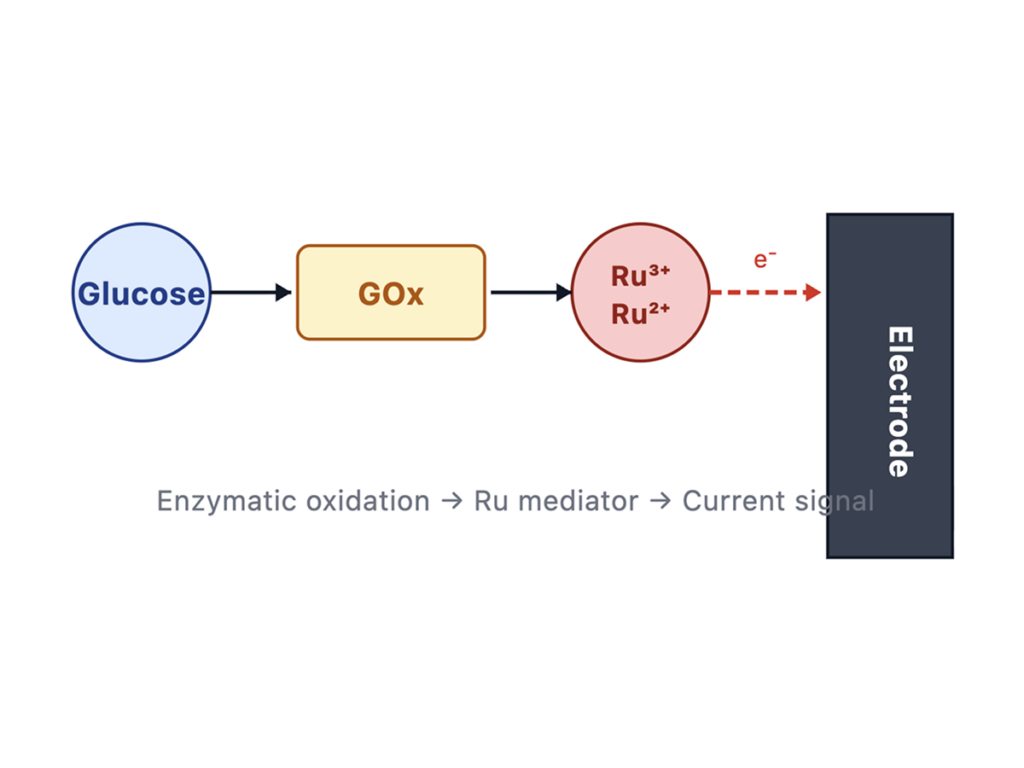
Application Flow — the role of the Ru mediator in a blood glucose measurement system
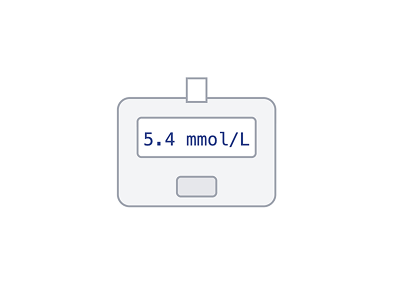
01 · BIOSENSOR · Glucose meter
Quantifies the electrochemical signal once the strip is inserted.
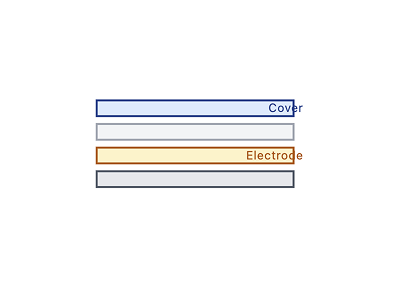
02 · STRIP · Test strip
A multilayer strip carrying an electrode layer coated with Ru compound.
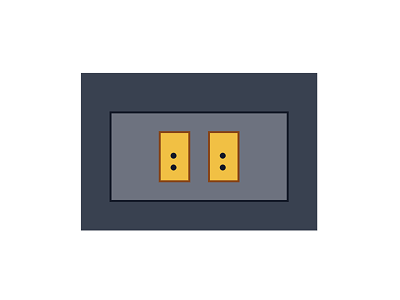
03 · ELECTRODE · Ru electrode layer
A working electrode uniformly coated with highly dispersed Ru compound.
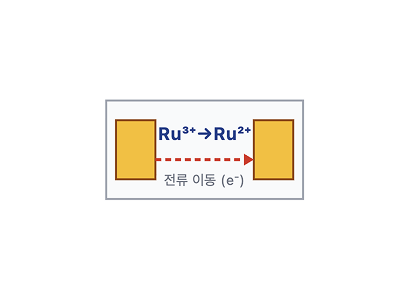
04 · MEDIATOR · Ru³⁺ → Ru²⁺
The redox reaction drives electron transfer and generates the current signal.
Reaction Mechanism
Glucose + GOx → Gluconolactone
Glucose in the blood is oxidized by an enzyme (GOx/GDH), releasing electrons. The Ru compound accepts those electrons as a mediator (Ru³⁺ → Ru²⁺), then re-oxidizes at the electrode to generate a measurable current.
- Fast electron transfer improves response speed
- Low oxygen dependence secures reproducibility
- Selective reaction minimizes the effect of interfering substances
Why LT Metal
Three engineering capabilities
Global customers choose LT Metal because our engineering capability in composition, structure, and reliability delivers the performance and quality they specify. That is our core strength.

We engineer composition.
We design biocompatible alloy compositions around the application site, the implant period, and the in-body environment — pH, temperature, and mechanical load. Where needed, we review biocompatibility test data with you to determine how the material should be applied.

We engineer structure.
We supply Pt-, Ir-, Au-, Rh-, and Ru-based materials as wire, powder, targets, and other forms. Custom small-lot processing is available, and we respond quickly to prototype requests at the R&D stage.

We engineer reliability.
We provide lot traceability documents, and certificates of composition — the documentation required for medical device approval and quality validation.

Start with LT Metal.
We engineer essential materials for tomorrow.
Your next challenge is our next design.
The precious metal material you choose determines your product’s performance and reliability. LT Metal works alongside you across the entire journey — material selection, joint development, volume supply, and recovery after use. Because a single material can move your product one step forward, LT Metal is already engineering the century ahead.
- Technical consultation — material selection, specification review, process compatibility assessment
- Request a sample — small-lot prototyping and evaluation support
- Precious metal recovery — assessment of precious metal content and recovery from spent materials
- Partnership proposal — long-term supply agreements, joint development projects