Electrical Contacts
In the instant electricity makes and breaks, the material decides everything.
Overview of Rivet Contacts
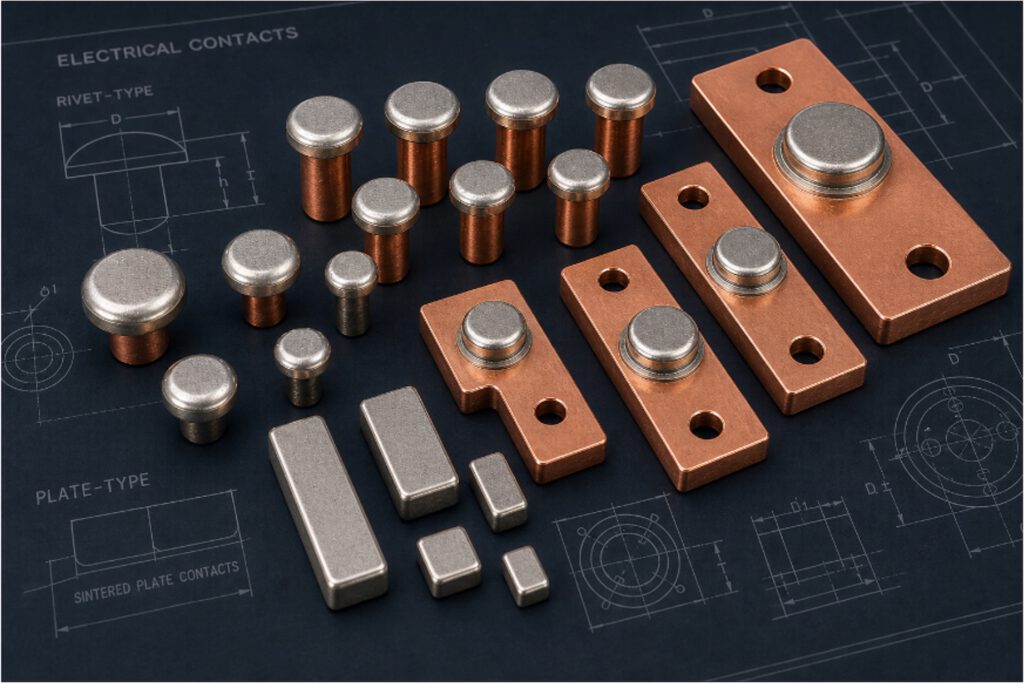
In today’s rapidly evolving electrical and electronic industries, electrical contacts are required to be smaller, demanding applications require higher-performing contact materials and more reliable. Backed by proven technology, LT Metal covers a wide range of contact materials — from AgCdO to environmentally friendly, high-performance cadmium-free grades — and a wide range of forms, from standard solid types to special shapes such as projection types, all under strict quality control.
Classification by Material
Rivet Contacts by Material
Pt Group
Pt Group
Suited to applications with low contact force where reliability is the primary concern. It does not oxidize or discolor at any temperature.
| Grade | Composition (wt%) |
Hardness (annealed, Hv) |
Melting Point ℃ (solidus) |
Electrical Conductivity (%IACS) |
Density (g/cm³) |
Thermal Conductivity (Cal/cm·sec·℃) |
Applications |
|---|---|---|---|---|---|---|---|
| Pt | 99.99 | 40 | 1769 | 17 | 21.45 | 0.17 | Telephones, relays, precision measuring instruments, railway signaling |
Pt-Ir Group
It has a strong arc-extinguishing capability and its contact resistance does not change. Hardness increases as the iridium content rises, and it does not discolor at all. It is suitable for high-speed, high-sensitivity applications operating under high contact force.
| Grade | Composition (wt%) |
Hardness (annealed, Hv) |
Melting Point ℃ (solidus) |
Electrical Conductivity (%IACS) |
Density (g/cm³) |
Thermal Conductivity (Cal/cm·sec·℃) |
Applications |
|---|---|---|---|---|---|---|---|
| Pt-Ir10 | Pt90-Ir10 | 126 | 1780 | 7.0 | 21.6 | 0.074 | Ignition magnetos, high-sensitivity relays, governors for micro motors, thermostats, induction regulators, alarm devices |
| Pt-Ir30 | Pt70-Ir30 | 285 | 1885 | 5.3 | 21.8 | 0.037 |
Au Group
Au
Its low electrical resistance and high corrosion resistance help prevent surface discoloration and oxide formation, when plated onto silver contacts used in light-load contacts that remain idle for long periods or are operated intermittently, as well as for silver contacts used in wireless applications.
| Grade | Composition (wt%) |
Hardness (annealed, Hv) |
Melting Point ℃ (solidus) |
Electrical Conductivity (%IACS) |
Density (g/cm³) |
Thermal Conductivity (Cal/cm·sec·℃) |
Applications |
|---|---|---|---|---|---|---|---|
| Au | 99.99 | 20 | 1063 | 71 | 19.3 | 0.7 | Communication connectors, brushes, plugs, commutator sockets |
Au Group
Used as a substitute for platinum in high-sensitivity devices. Its resistance to electrical erosion is lower, but it offers better welding resistance and hardness than silver.
| Grade | Composition (wt%) |
Hardness (annealed, Hv) |
Melting Point ℃ (solidus) |
Electrical Conductivity (%IACS) |
Density (g/cm³) |
Thermal Conductivity (Cal/cm·sec·℃) |
Applications |
|---|---|---|---|---|---|---|---|
| AuAg90 | Au10Ag90 | 29 | 965 | 48 | 11.0 | 0.47 | Slip ring brushes, DC signaling devices, telecom circuit breakers, switchboards |
| AuAg30 | Au10Ag30 | 32 | 1025 | 16 | 16.6 | 0.16 |
Excellent corrosion resistance, low contact resistance and a long service life make it highly reliable. It is also known as PGS.
| Grade | Composition (wt%) |
Hardness (annealed, Hv) |
Melting Point ℃ (solidus) |
Electrical Conductivity (%IACS) |
Density (g/cm³) |
Thermal Conductivity (Cal/cm·sec·℃) |
Applications |
|---|---|---|---|---|---|---|---|
| AuAgPt | – | 60 | 1100 | 11.0 | 17.1 | 0.12 | Heavy-current telecom devices, controllers |
Offers excellent corrosion resistance together with excellent mechanical properties.
| Grade | Composition (wt%) |
Hardness (annealed, Hv) |
Melting Point ℃ (solidus) |
Electrical Conductivity (%IACS) |
Density (g/cm³) |
Thermal Conductivity (Cal/cm·sec·℃) |
Applications |
|---|---|---|---|---|---|---|---|
| AuNi5 | Au95Ni5 | 120 | 1020 | 12.9 | 18.3 | – | Heavy-duty telecom contacts |
An alloy containing 62.5% gold, produced in wire or strip form. It withstands impact contact well, has good spring properties and does not discolor at all.
| Grade | Composition (wt%) |
Hardness (annealed, Hv) |
Melting Point ℃ (solidus) |
Electrical Conductivity (%IACS) |
Density (g/cm³) |
Thermal Conductivity (Cal/cm·sec·℃) |
Applications |
|---|---|---|---|---|---|---|---|
| AuAgCu | Au62.5 Ag30 Cu7.5 | 165 | 861 | 12.0 | 13.7 | 0.13 | – |
Pd Group
AgPd Group
It is completely resistant to the formation of sulfide films. At a silver content of 40% it reaches maximum hardness and wear resistance, and it is used as a substitute for platinum.
| Grade | Composition (wt%) |
Hardness (annealed, Hv) |
Melting Point ℃ (solidus) |
Electrical Conductivity (%IACS) |
Density (g/cm³) |
Thermal Conductivity (Cal/cm·sec·℃) |
Applications |
|---|---|---|---|---|---|---|---|
| AgPd30 | Ag70Pd30 | 60 | 1225 | 11.5 | 10.9 | 0.11 | Automotive fuel gauges, sliding contact material for telephone relays, signaling devices, commutator brushes, thermostats (small DC), industrial instruments |
| AgPd40 | Ag60Pd40 | 65 | 1290 | 8.2 | 11.1 | 0.1 | |
| AgPd50 | Ag50Pd50 | 75 | 1350 | 5.7 | 11.2 | 0.06 | |
| AgPd60 | Ag40Pd60 | 80 | 1395 | 4.3 | 11.4 | 0.07 | |
| AgPd70 | Ag30Pd70 | 90 | 1430 | 4.3 | 11.5 | – |
Ag Group
Ag Group
Silver has the highest electrical and thermal conductivity of any metal, does not oxidize, and maintains low contact resistance even under low contact force. It cannot be used where the air contains sulfur, which forms a sulfide film on the surface.
| Grade | Composition ( wt%) |
Hardness (annealed, Hv) |
Melting Point ℃ (solidus) |
Electrical Conductivity (%IACS) |
Density (g/cm³) |
Thermal Conductivity (Cal/cm·sec·℃) |
Applications |
|---|---|---|---|---|---|---|---|
| Ag | 99.99 | 26 | 960 | 106 | 10.5 | 1.0 | Communication contacts, thermostats, micro relays, rotary switches, telephones, small breakers, home appliance switches |
| AgF | Ag99.93Cu0.07 | 28 | 960 | 106 | 10.5 | – | |
| AgS | Ag99.97Cu0.03 | 28 | 960 | 106 | 10.5 | – | |
| AgH | Ag99.97Ni0.03 | 28 | 960 | 106 | 10.5 | – | |
| AgNi0.15 | Ag99.85Ni0.15 | 30 | 960 | 106 | 10.5 | – | |
| AgNi0.2 | Ag99.80Ni0.20 | 30 | 960 | 106 | 10.5 | – |
AgNi Group
AgNi Group
AgNi alloy is a contact material that improves the welding resistance and wear resistance of silver while enhancing workability. Because nickel does not dissolve into silver, it is produced by powder metallurgy, and a nickel content of 5 to 20 wt% is most commonly used.
| Grade | Composition (wt%) |
Hardness (annealed, Hv) |
Melting Point ℃ (solidus) |
Electrical Conductivity (%IACS) |
Density (g/cm³) |
Thermal Conductivity (Cal/cm·sec·℃) |
Applications |
|---|---|---|---|---|---|---|---|
| AgH | Ag99.97Ni0.03 | 35 | 960.5 | 106 | 10.5 | 1.0 | DC sliding contacts, rotary switches, home appliance breakers, appliance wiring switches, circuit breaker switches, relays, push-buttons |
| AgNi0.2 | Ag99.8Ni0.2 | 40 | 960.5 | 106 | 10.5 | 1.0 | |
| AgNi10 | Ag90Ni10 | 65 | 960.5 | 91 | 10.3 | – | |
| AgNi15 | Ag85Ni15 | 73 | 960.5 | 88 | 10.3 | – | |
| AgNi20 | Ag80Ni20 | 80 | 960.5 | 83 | 10.2 | – | |
| AgNi30 | Ag70Ni30 | 60 | 960.5 | 16 | 10.0 | – | |
| AgNi40 | Ag60Ni40 | 80 | 960.5 | 9 | 9.8 | – |
AgCu Group
AgCu Group
As the copper content rises, tarnish resistance decreases while hardness and mechanical wear resistance increase. It cannot be used where contact force is high and sliding contact occurs during operation.
| Grade | Composition (wt%) |
Hardness (annealed, Hv) |
Melting Point ℃ (solidus) |
Electrical Conductivity (%IACS) |
Density (g/cm³) |
Thermal Conductivity (Cal/cm·sec·℃) |
Applications |
|---|---|---|---|---|---|---|---|
| S97 | Ag97Cu3 | 45 | – | 92 | 10.4 | – | Rotary switches, thermostats, commutator switches, tuners, relays, home appliance switches, vending machines |
| AgCu10 | Ag90Cu10 | 62 | 778 | 86 | 10.3 | 0.80 | |
| AgCu20 | Ag80Cu20 | 85 | 778 | 82 | 10.2 | 0.82 | |
| AgCuNi0.5 | AgCu24.5Ni0.5 | 115 | 810 | 68 | 10.1 | – | |
| AgCu40 | AgCu40 | 95 | 778 | 82 | 9.8 | – |
AgCdO Group
AgCdO Group
AgCdO grades are produced with silver-cadmium oxide as the main constituent. As a contact material it offers excellent welding and wear resistance, stable contact resistance and good electrical and thermal conductivity. It is currently used widely for medium-current contacts.
| Grade | Composition (wt%) |
Hardness (annealed, Hv) |
Melting Point ℃ (solidus) |
Electrical Conductivity (%IACS) |
Density (g/cm³) |
Thermal Conductivity (Cal/cm·sec·℃) |
Applications |
|---|---|---|---|---|---|---|---|
| HE100 | Ag90CdO10 | 70 | 960.5 | 80 | 10.2 | – | AC relays and switches, home appliance breakers, magnetic switches, no-fuse breakers, motor breakers, heavy-load connectors |
| HE120 | Ag88CdO12 | 70 | 960.5 | 80 | 10.2 | – | |
| HE130 | Ag86.5CdO13.5 | 75 | 960.5 | 78 | 10.1 | – | |
| HE140S | Ag85.3CdO14.7 | 75 | 960.5 | 77 | 10.1 | – | |
| HE181 | Ag82.9CdO+α17.1 | 80 | 960.5 | 75 | 10.0 | – | |
| HE181F | Ag82.9CdO17.1 | 80 | 960.5 | 75 | 10.0 | – |
AgSnO Group (Cd FREE)
AgSnO2 Group (powder metallurgy)
A material in which SnO2 powder is dispersed in a silver matrix by powder metallurgy. It maintains excellent electrical conductivity while improving arc resistance, welding resistance and erosion resistance.
| Grade | Composition (wt%) |
Hardness (annealed, Hv) |
Melting Point ℃ (solidus) |
Electrical Conductivity (%IACS) |
Density (g/cm³) |
Thermal Conductivity (Cal/cm·sec·℃) |
Applications |
|---|---|---|---|---|---|---|---|
| HFE10S | Ag90MOx10 | 80 | 960.5 | 90 | 10.0 | – | AC switches and relays, home appliance breakers |
| HFE12S | Ag88MOx12 | 90 | 960.5 | 85 | 9.9 | – |
AgSnO2 Group (internal oxidation)
An oxide-dispersion-strengthened silver alloy made by the full oxidation process. SnO2 is thermally stable by nature and is finely distributed through the silver matrix, giving outstanding arc resistance, welding resistance and erosion resistance. It performs particularly well in relays and switches handling medium DC loads.
| Grade | Composition (wt%) |
Hardness (annealed, Hv) |
Melting Point ℃ (solidus) |
Electrical Conductivity (%IACS) |
Density (g/cm³) |
Thermal Conductivity (Cal/cm·sec·℃) |
Applications |
|---|---|---|---|---|---|---|---|
| HFE90 | Ag91MOx9 | 110 | 960.5 | 73 | 10.0 | – | Automotive relays and switches, heavy-load circuit breakers, power switches, magnetic switches |
| HFE120 | Ag88MOx12 | 115 | 960.5 | 70 | 9.9 | – |
AgSnO₂-In₂O₃ (Cd free)
AgSnO₂-In₂O₃ group
A cadmium-free material developed to meet environmental requirements. Produced by internal oxidation of an Ag-Sn alloy with several additional alloying elements, it contains very finely dispersed oxide particles, giving excellent welding resistance and erosion resistance.It is used for both AC and DC loads.
| Grade | Composition (wt%) |
Hardness (annealed, Hv) |
Melting Point ℃ (solidus) |
Electrical Conductivity (%IACS) |
Density (g/cm³) |
Thermal Conductivity (Cal/cm·sec·℃) |
Applications |
|---|---|---|---|---|---|---|---|
| HFE90 | Ag91MOx9 | 110 | 960.5 | 73 | 10.0 | – | Automotive relays and switches, heavy-load circuit breakers, power switches, magnetic switches |
| HFE120 | Ag88MOx12 | 115 | 960.5 | 70 | 9.9 | – | |
| SJ06 | Ag90MOx10 | 100 | 960.5 | 75 | 10.1 | – | General-purpose relays and switches, magnetic switches, AC lamp / motor / resistive loads, molded case circuit breakers, automotive electrical relays |
| SJ23 | Ag87.5MOx12.5 | 105 | 960.5 | 70 | 9.9 | – | |
| SJ25P | Ag85.5MOx14.5 | 95 | 960.5 | 70 | 9.8 | – | |
| SJ160 | Ag84.0MOx16.0 | 105 | 960.5 | 68 | 9.8 | – | |
| EP45 | Ag85.5MOx14.5 | 105 | 960.5 | 70 | 9.8 | – | |
| MS45 | Ag85.5MOx14.5 | 100 | 960.5 | 70 | 9.8 | – |
AgZnO Group
AgZnO Group
A cadmium-free material with no environmental concerns, produced by internal oxidation of an Ag-Zn alloy. Finely dispersed oxide particles improve welding and erosion resistance, making it an alternative to AgCdO. It is used mainly in AC switches and magnetic switches.
| Grade | Composition (wt%) |
Hardness (annealed, Hv) |
Melting Point ℃ (solidus) |
Electrical Conductivity (%IACS) |
Density (g/cm³) |
Thermal Conductivity (Cal/cm·sec·℃) |
Applications |
|---|---|---|---|---|---|---|---|
| SZ1 | Ag91.0MOx9.0 | 77 | 960.5 | 80 | 10.1 | – | Home appliance switches, magnetic switches |
| SZ2 | Ag90.4MOx9.6 | 80 | 960.5 | 78 | 10.1 | – |
Other
AgCdNi Group
Used as a substitute for the Ag-Cu series. Its tarnish resistance is better than the Ag-Cu series, but its contact resistance is inferior.
| Grade | Composition (wt%) |
Hardness (annealed, Hv) |
Melting Point ℃ (solidus) |
Electrical Conductivity (%IACS) |
Density (g/cm³) |
Thermal Conductivity (Cal/cm·sec·℃) |
Applications |
|---|---|---|---|---|---|---|---|
| AgCdNi0.5 | Ag97.6CdNi2.4 | 55 | 850 | 80 | 10.3 | 0.24 | Voltage regulators, thermostats, switches, overload control relays |
AgIn Group
It is self-lubricating and is used as a sliding contact under relatively high contact pressure.
| Grade | Composition (wt%) |
Hardness (annealed, Hv) |
Melting Point ℃ (solidus) |
Electrical Conductivity (%IACS) |
Density (g/cm³) |
Thermal Conductivity (Cal/cm·sec·℃) |
Applications |
|---|---|---|---|---|---|---|---|
| AgIn18 | Ag82 In18 | 60 | 730 | – | 9.7 | – | Wipers for type-A switchboards, rotary switches, low-noise switches |
Advantages
Advantages of Rivet Contacts
01
Assembly is relatively simple.
02
For contacts used in the low-current range, the contact force achieved by riveting is more than strong enough and stays stable.
03
Because no heat is applied, the base material keeps its spring properties and does not oxidize.
Types and Applications
Rivet Contact Types and Applications
Solid Type
The single-metal contact in general use.
Clad Type
A composite contact that uses less material than a solid contact to improve cost efficiency.
Tubular Type
A contact riveted onto fragile base materials such as bakelite and other synthetic resins.
Conical Type
Used in combination with an F-type contact where contact resistance matters. It helps prevent contact failure caused by corrosion, and is usually gold-plated.
Double Clad Type
Contact material is bonded to both ends. It is a composite contact that uses less material than the solid type.
Where They Are Used
Where Rivet Contacts Are Used
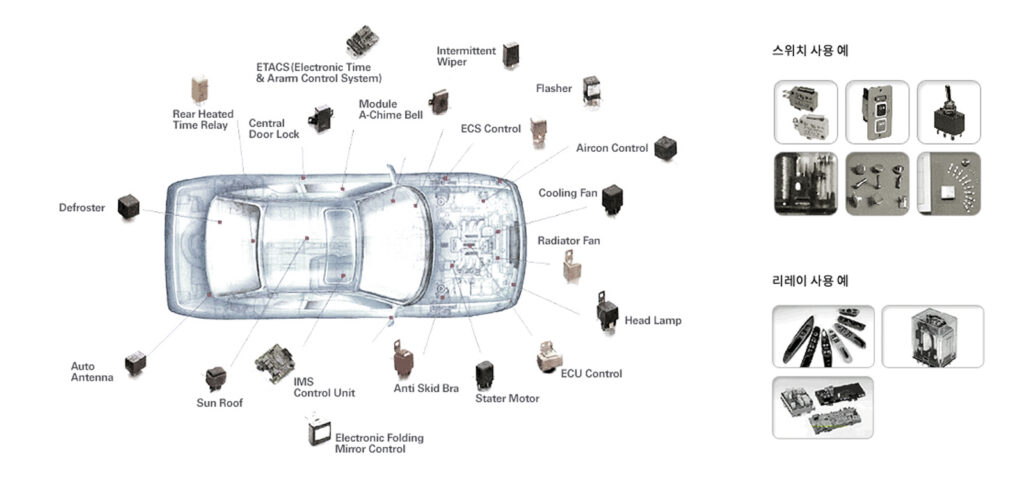
Used in switches, relays, electromagnetic contactors and similar devices.